It happens every time a major Google algorithm update rolls out. The panic sets in. Lately, the messages in my inbox all share a similar theme: “My rankings haven’t dropped, but my traffic is vanishing. What is going on?”
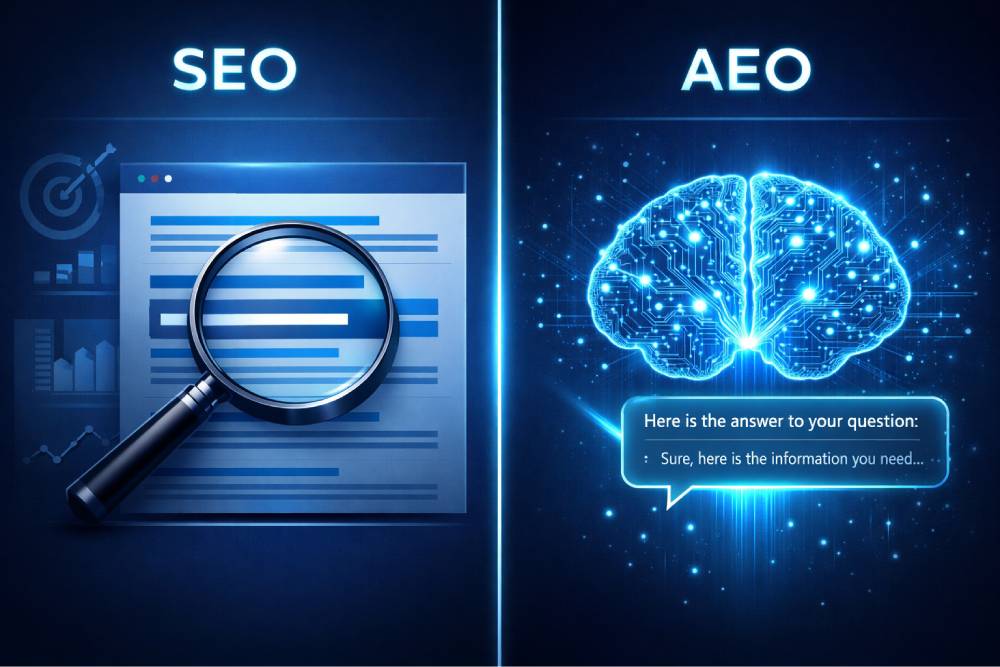
The answer is both simple and paradigm-shifting. The internet is undergoing a foundational change in how users retrieve information. We are transitioning from a world where people search for links to a world where they ask for answers. If you are struggling to understand the main difference between SEO and AEO in 2026, you are not alone. Most digital marketing advice is still stuck in the past, treating these two concepts as a rivalry.
As an educational platform dedicated to giving you the no-fluff truth about digital marketing, we need to set the record straight. You don’t have to choose between them. You need to master how they work together. Let’s dive into the core differences and how you can future-proof your website.
The Great Search Split of 2026
To understand the AEO vs SEO strategy for 2026, we have to redefine the playing field. For the last two decades, Search Engine Optimization (SEO) was the only game in town. Today, Answer Engine Optimization (AEO) has arrived not as a replacement, but as an aggressive filter layered right on top of it.
SEO: The Foundation of Discovery
Think of standard SEO as the infrastructure of the web. It is the Dewey Decimal System of the internet. By focusing on site architecture, backlinks, and comprehensive content, your goal is to prove to search engines that your website belongs in the library. If you are just starting out, reading a beginner SEO guide to rank on Google will teach you how to get your books on the shelf.
AEO: The Layer of Selection
If SEO puts your book in the library, AEO is the librarian who reads your book, memorizes the best parts, and recites the exact answer to a patron so they never have to check the book out.
Answer engines – like Google’s AI Overviews, ChatGPT, and Perplexity – bypass the “blue links.” They scrape the top results, synthesize the information, and present a direct answer. AEO is the practice of formatting your digital content so that these AI models choose you as the source material.
3 Crucial Differences Most Marketers Miss
When we break down what the real difference is between SEO and AEO, it goes much deeper than just “voice search vs. text search.” It fundamentally changes how we value our content.
-
Clicks vs. Citations: The New Currency of the Web
In traditional SEO, a ranking is worthless if it doesn’t generate a click. The entire financial model of the web was built on traffic.
In the AEO era, we have to accept the reality of zero-click searches and their SEO impact. Over 65% of queries now end without the user ever clicking a link. In AEO, the “Citation” is the new currency. When an AI provides an answer and tags your brand as the source, you win an “impression of authority.”
The Citation Scenario: A user asks an AI, “What are the most common mistakes beginners make with Google Ads?” If the AI responds using data from your site and adds a small source link to your article on Google Ads for beginners mistakes, the user gets their answer immediately. They didn’t click. But your brand was just validated by an artificial intelligence. That builds massive, top-of-mind trust for when they are actually ready to buy software or take a course.
-
Keyword-Matching vs. Entity-Recognition
Standard SEO has evolved, but it still heavily relies on topical keyword mapping. If you want to rank for “best CRM,” you need those words and their semantic variations on the page.
AEO operates on “Entities.” AI language models view the world as a massive Knowledge Graph of interconnected concepts, people, and brands. When you read about the ChatGPT traffic impact on AI and SEO, the underlying lesson is that AI doesn’t just read your words; it evaluates your reputation. If your brand is widely recognized across the web as an authority in “small business marketing,” the AI will inherently trust your answers more than a brand-new site spamming the exact keyword.
-
The “Extraction Tax”: Long-Form Depth vs. Extractable Clarity
This is where most brilliant writers fail in 2026. You can write a 3,000-word masterpiece that ranks #1 in standard SEO. But if your answers are buried deep within long, winding paragraphs, the AI won’t use them.
AI models have a “computational budget.” They want to extract facts quickly. If your content isn’t formatted with clear, punchy, extractable data blocks, the AI will skip your #1 ranked article and pull the answer from the #4 ranked article that used a bulleted list.
The “Hybrid” Content Framework (The Digistir360 Method)
You cannot afford to create separate pages for SEO and AEO. You need a hybrid structure that satisfies the deep-dive reader (SEO) and the rapid-extraction AI (AEO) simultaneously.
The Inverted Pyramid for the AI Era
Journalists have used the inverted pyramid for over a century: give the most critical information first, then provide the background details later. We must apply this to our blog structure for SEO.
Whenever you introduce a new H2 or H3 subheading, do not write a fluffy, “hook” transition sentence. Provide the direct answer immediately in the first 40 to 50 words.
- Bad (Fluff): “When it comes to learning about the differences between these two platforms, many people wonder which is better. Let’s explore the various features of Facebook and Instagram…”
- Good (AEO-Optimized): “The main difference is audience intent. Facebook is ideal for community building and local targeted ads, while Instagram excels at highly visual product discovery and influencer partnerships.” (See our Instagram vs Facebook marketing guide for more).
By placing the direct answer right beneath the heading, you make it incredibly easy for an Answer Engine to “snip” your text for a featured snippet or position zero result.
Structural Must-Haves: Schema, Semantic Tags, and Safe Zones
Machines need labels. To win the AEO game, you must use structured data.
If you have a Q&A section at the bottom of your post, wrapping it in standard text isn’t enough. You must deploy schema markup. We highly recommend walking through a FAQ schema tutorial for the Rank Math SEO plugin to learn how to inject this code. This explicitly tells the AI: “Here is the question. Here is the exact answer.” It removes the guesswork for the machine.
Furthermore, consider voice search. People speak to their phones differently than they type on keyboards. As detailed in our local SEO for voice search beginners guide, incorporating conversational long-tail keywords (like “Where can I find…” or “How much does it cost to…”) directly aligns with AEO algorithms.
Off-Page AEO: Your Reputation Outside Your Website
Here is a reality check: AI models are increasingly crowdsourcing the truth. They do not just scrape your website to see what you say about yourself; they scrape forums, review sites, and social media to see what the public says about you.
Why Reddit and Forums are the New “Backlinks” for AI
In standard SEO, a hyperlink from a high-authority site is a vote of confidence. In AEO, a highly upvoted mention of your brand in a specialized community is a vote of confidence.
If a user on a forum asks, “What’s the best free tool for graphic design?” and twenty people reply with “Canva,” the AI learns that Canva is the definitive entity for that query. If you are learning how to use Canva or trying to promote your own tools, you must be present in the conversation.
Building Authority through Community
This makes community engagement a vital part of your content strategy. Learning the nuances of Reddit marketing for beginners or maintaining an active presence with a proper Facebook business page setup feeds the AI’s understanding of your brand’s legitimacy. The more your brand is discussed positively in the “Hidden Web” (forums and social comments), the more confidently an AI will cite you as an expert.
Measuring Success: New KPIs for a Zero-Click World
If traffic isn’t the only metric anymore, how do you prove your marketing is working? You have to shift your Key Performance Indicators (KPIs).
Beyond Google Search Console: Tracking AI Share of Voice
Traditional rank tracking tools will tell you if you are #3 for a keyword. But they won’t easily tell you if ChatGPT is recommending you. You need to manually test this. Regularly prompt major AI engines with questions your target audience asks. Is your brand being cited? Are your free marketing tools for beginners being recommended? Tracking your “Citation Share” across different AI models is the new rank tracking.
The “Brand Lift” Metric: When Invisible Traffic Becomes Real Leads
Even if AEO doesn’t result in an immediate click, it generates awareness.
The Brand Lift Calculation: Look at your analytics and isolate “Direct Traffic” and searches for your “Brand Name” over the last 6 months. If your overall organic traffic has dipped by 15% (due to zero-click AI answers), but your Brand Name searches and Direct Traffic have increased by 20%, you are successfully executing AEO.
Users are getting their answers from the AI, remembering your name, and coming directly to your site when they need to take action – like deciding to build an email list for beginners using your templates.
Conclusion: Adapt or Fade
The debate between SEO and AEO is ultimately a distraction. Standard SEO ensures that search engines can crawl, index, and understand the depth of your website. AEO ensures that artificial intelligence can quickly extract, synthesize, and recommend your expertise.
For small businesses and solo marketers, this transition isn’t a penalty; it’s an equalizer. You no longer need the massive link-building budgets of corporate giants to win. If you provide the clearest, most accurate, and most structured answer to a user’s question, the AI will choose you.
Stop writing to game an algorithm, and start writing to be the undisputed answer in your industry.
Confused between SEO and AEO? This clears it up. Dive into our comprehensive Answer Engine Optimization guide to build a digital strategy that thrives in the AI era.